

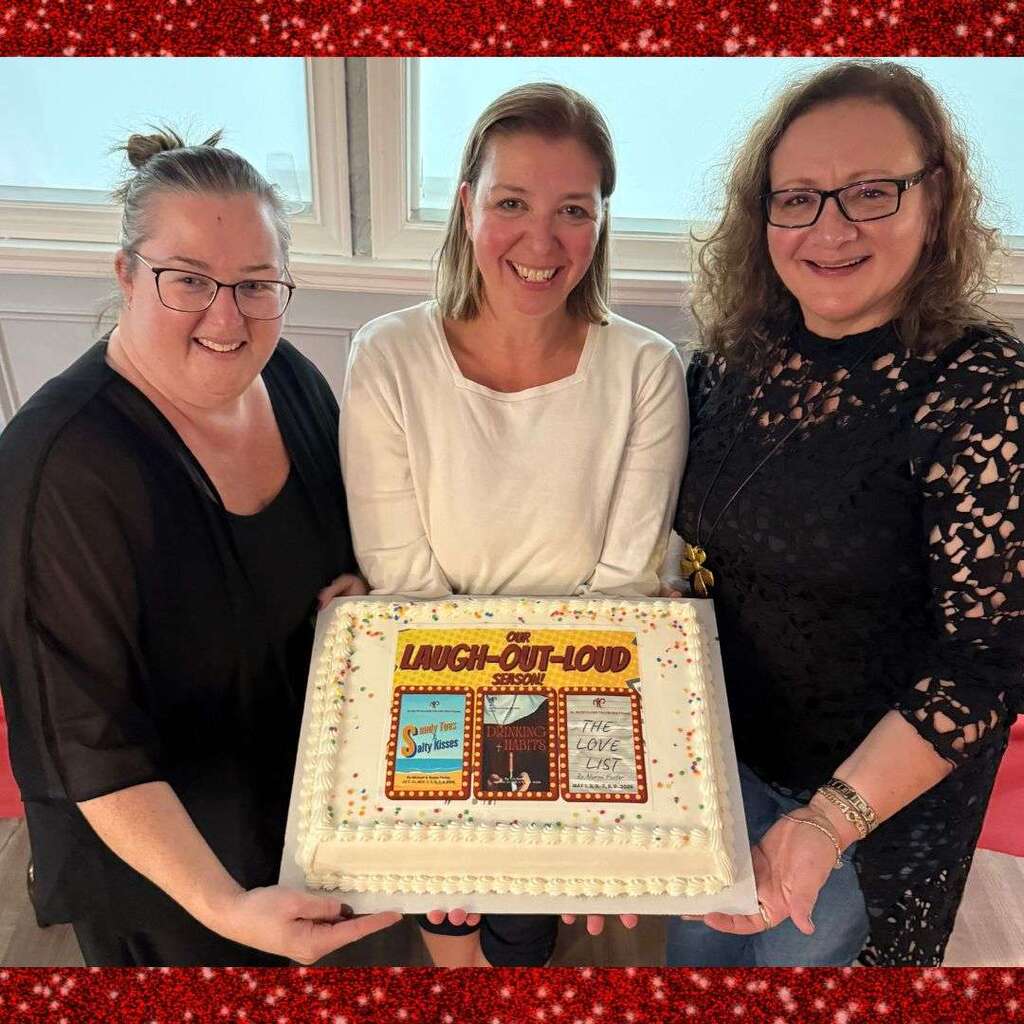
Pictured left to right: Sandra Curran, Jennifer Brown, Rosanna Armata
The Milton Players Theatre Group enters its 46th season with our fantastic Laugh-Out-Loud trio of comedies: Sandy Toes & Salty Kisses, Drinking Habits and The Love List. In anticipation of the laughter to come, we sat down with our roster of all-female directors to pick their brains about what goes into putting together a great show!
What drew you to the script you’re directing?
Sandra Curran (Director, Sandy Toes & Salty Kisses): I was physically laughing out loud when I read this script. It had a lot of realistic people in crazy situations, but anyone watching could put themselves in those situations.
Jennifer Brown (Director, Drinking Habits): I fell in love with the humour, the characters, the relationships and the setting of the play. I knew I needed to direct this play and bring my vision to light.
Rosanna Armata (Director, The Love List): I’m a fan of Canadian playwright, Norm Foster. I enjoy how his plays are relatable and timeless for audiences of all ages. The Love List is funny, provocative, engaging and highly entertaining. It’s a show that asks you to consider the best qualities in your ideal partner, and whether what we want in a partner is often what we really need for a satisfying relationship.
How is directing different from other roles you’ve taken on in theatre (ie. acting, stage-managing)? Do you have a preference?
SC: I have really only stage-managed and it is very different. As a director, you have to have a vision and an execution for the vision. As a stage manager, you go along with the director’s vision and make sure everything is running on time. I really don’t prefer one to the other as they are different.
JB: As an actor, I was focused on my character’s lines and personality. Now, I need to look at the whole production – from costumes to sets to each character’s unique personality – and how every small detail comes together to tell a hilarious and entertaining story.
RA: The majority of my theatre experience has focused on acting across the Peel and Halton regions of Ontario. After years of observing and learning from a number of talented theatre directors, I enrolled in a couple of classes before directing one-act plays and a mainstage show — and I’ve been hooked ever since.
The difference between acting and directing is primarily one of vantage point. An actor’s main focus is on stage: their character’s development, listening and responding organically to others, and fully embodying their role. A director, on the other hand, must consider the entire vision — all actor portrayals and character arcs, staging, lighting, sound, storytelling nuances like pacing and subtle telegraphing, as well as props. The director is responsible for the collaboration of all these creative elements in the satisfying and rewarding pursuit of fully entertaining audiences.
What advice would you give first-time directors?
SC: Know what you want and make sure you are clear in how you let everyone involved in the show know, from the actors to the props to the set decor. There are many moving parts, so making sure everyone knows what your vision is allows you to focus on the show itself.
JB: Use your time wisely and ask for help. My production team is keeping me afloat. I couldn’t ask for a better group of people.
RA: Think back to successful show runs that you have been involved with and consider the director’s approach to working with all members of the production team. Ask another director you admire to mentor you or offer feedback on your vision for your own show.
What do you look for in auditions when casting a show?
SC: I love auditions. I look for how people interact with the other actors auditioning (during and while waiting) and if they bring something new to the character that I may not have thought of.
JB: I’m looking for a dedicated group of people who want to have fun and be a part of a team. I’m hoping they bring their own ideas on how to make their character great and memorable for the audience.
RA: Chemistry between actors while in-character, and the ability of an actor to follow direction well.
What is the biggest challenge you face when directing? How do you overcome it?
SC: The biggest challenge was when we didn’t have enough people audition to cast the roles (for Sandy Toes & Salty Kisses). It’s a stressful situation to be in. The best way to overcome it is to reach out to your surrounding theatre groups in hopes that they will recommend someone or send a notice to their members.
RA: As a director, I’ve experienced auditions where I’ve been fortunate enough to have many talented actors try out, and many of them longstanding theatre friends. However, there are only so many parts in a show, and anyone who knows me knows I won’t compromise the integrity of a show’s performance (or my own integrity) by casting friends over the sake of a well-deserving actor.
It will always come down to chemistry between the actors while in-character, and unfortunately, I sometimes have to make that dreadful call to really talented, longstanding friends to tell them they didn’t get the part, this time. And yes, it sucks and hurts my heart every time.
Why do you feel theatre is important? What do you see as the continuing appeal of live theatre?
SC: Theatre is important because it allows people to submerse themselves into a world that may be very different than their own lives. It allows them to laugh at situations that some may find a bit like reality. Theatre is more personal than a movie – it touches people’s hearts. I believe people love going because anything can happen with live theatre!!
JB: In a world being taken over by computers and A.I., more than ever we need to connect with our human side. Live entertainment is not only fun but makes you part of the experience. It’s totally unpredictable and anything can happen.
RA: A well-written, relatable script, performed live by a talented cast and showcased by a creative production team is simply entertaining – and frankly, therapeutic – for all involved, especially audiences wanting an escape from their own lives for a few hours.
To learn more about the shows they’re directing and to save money on individual tickets by purchasing a 3-Show Subscription Series, CLICK HERE!
The Milton Players would like to thank Sandra Curran, Jennifer Brown and Rosanna Armata for participating in this Q&A.
Sandy Toes & Salty Kisses opens Oct. 31st and runs Nov. 1st, 2nd,6th,7th and 8th 2025
Drinking Habits opens Jan 30th and runs Jan 31st, Feb 1st, 5th 6th and 7th 2026.
The Love List opens May 1st and runs May 2nd, 3rd, 7th, 8th and 9th 2026.